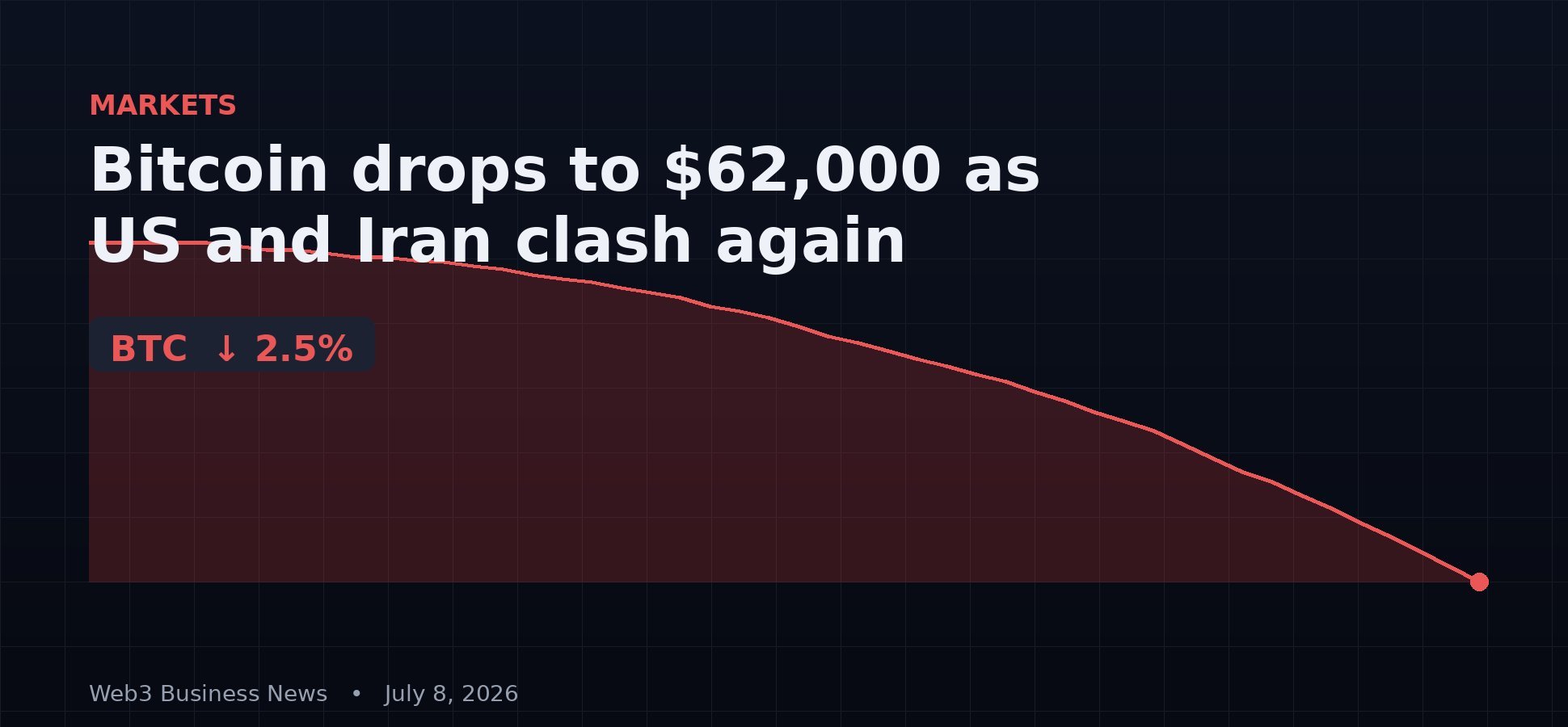
Bitcoin fell to about $62,000 on Wednesday after the United States and Iran exchanged fresh airstrikes, sending crypto and equity markets into a broad risk-off retreat. The CoinDesk 20 Index, which tracks the largest digital assets, dropped 2.9% from midnight UTC, with all but one token in the red. Ether fell more than 2%, and smaller tokens took steeper losses. The move followed comments from US President Donald Trump, who told NATO leaders the ceasefire with Iran was “over” and called further talks a “waste of time.” Traders stepped back from higher-risk assets as oil climbed and the dollar firmed.
Much of the damage came through liquidations. A liquidation is the forced closing of a leveraged trading position when a trader’s collateral no longer covers the loss.
Key takeaways
- Bitcoin slipped about 2.5% to roughly $62,000 and the CoinDesk 20 Index fell 2.9% on July 8 after renewed US and Iran airstrikes.
- Total liquidations reached about $450 million, with roughly $350 million from altcoin positions. JUP, ETHFI, and PUMP lost between 5.5% and 9.3%.
- Solana erased its entire July rally, trading near $77 after touching $84 on Monday.
- WTI crude rose more than 2% to $72.27 and the US Dollar Index held above 101 as investors moved to safer assets.
Published: July 8, 2026, 18:00 UTC
What triggered the selloff
US Central Command said it struck more than 60 Islamic Revolutionary Guard Corps small boats to stop them disrupting shipping in the Strait of Hormuz, according to CoinDesk. Iran responded with attacks on Kuwait and Bahrain and said it had targeted 85 US military installations. The exchange pushed an already fragile ceasefire close to collapse.
The conflict first erupted in late February 2026, sending oil above $100 a barrel and delivering a global inflation shock. Prices later fell back below $60, but consumer inflation expectations kept climbing. That backdrop is what links a Middle East flare-up to token prices. Renewed fighting lifts oil and revives fears of higher interest rates, and higher rates make safe bond yields more attractive than volatile assets such as bitcoin. Bitcoin had reclaimed $60,000 earlier this month, so the pullback unwinds part of that recovery.
How crypto markets reacted
Altcoins bore the brunt. Of the roughly $450 million in positions liquidated, about $350 million came from altcoin pairs, according to CoinGlass. Solana retraced a rally that began on July 2, falling back to about $77 after challenging $84 on Monday. Tokens including JUP, ETHFI, and PUMP dropped between 5.5% and 9.3%.
Not every corner sold off. MORPHO rose 4% as total value locked on the lending protocol reached a record 4 million ETH, according to DefiLlama. Bitcoin, despite the drop, stayed up about 6% for the month. The resilience follows a stretch of steady demand that included a return of spot ETF inflows at the start of July.
US equities followed crypto lower. Nasdaq 100 and S&P 500 futures fell as much as 1.5%, a reminder that digital assets still trade closely with broader risk sentiment during macro shocks.
What the derivatives market shows
Positioning data points to caution rather than panic. Futures open interest in bitcoin slipped to 730,000 BTC from more than 740,000 a day earlier, a sign traders trimmed exposure rather than piling into short bets. Open interest is the total number of outstanding derivative contracts that have not yet been settled.
Options traders paid up for protection. On the Deribit exchange, the one-week skew jumped to nearly 20% in favor of puts from 16% a day earlier, meaning demand rose for contracts that pay out if prices keep falling. Implied volatility gauges for bitcoin and ether climbed for a second straight day, another sign the market is bracing for more swings while the conflict stays unresolved.
Frequently asked questions
Why did crypto fall on July 8, 2026?
Prices dropped after the US and Iran exchanged fresh airstrikes and President Trump declared the ceasefire over. The escalation lifted oil and the dollar and revived fears of higher interest rates, pushing investors out of higher-risk assets including bitcoin, ether, and smaller tokens.
How much was liquidated during the selloff?
About $450 million in leveraged positions were closed, according to CoinGlass. Roughly $350 million came from altcoin trading pairs, with tokens such as JUP, ETHFI, and PUMP falling between 5.5% and 9.3% as thinner liquidity amplified the moves.
Is bitcoin still up despite the drop?
Yes. Even after slipping to around $62,000, bitcoin remained up roughly 6% for July. Futures open interest fell only modestly, which suggests traders reduced exposure rather than betting heavily on further declines.